Conquering the Green Hell
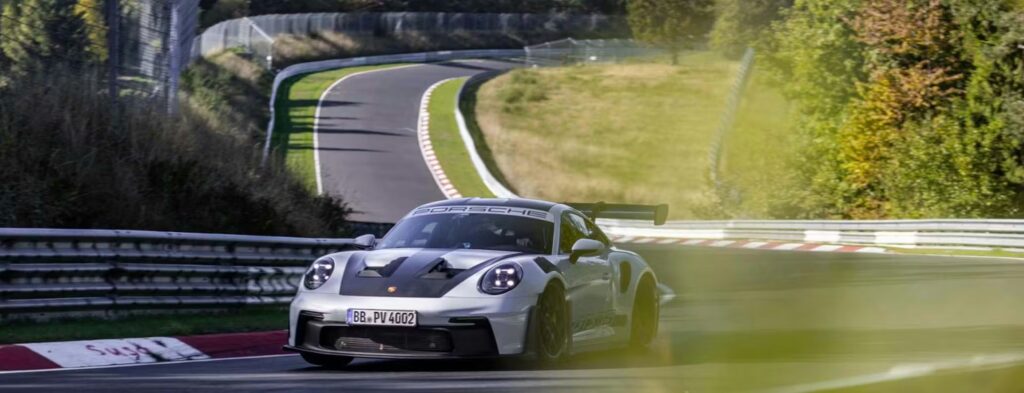
The GT3 RS Nürburgring achievement represents one of the most impressive modern performances delivered by a naturally aspirated production car. Recording a 6:49.3 lap time on the Nordschleife is not simply about raw speed; it is about sustaining precision under relentless pressure. That figure reflects aerodynamic balance at high velocity, mechanical consistency under stress, and absolute driver confidence when operating at the limit. In today’s era of hybrid-assisted hypercars and electric torque surges, achieving such a result without forced induction highlights the depth of engineering refinement behind this machine.
The Nürburgring circuit stretches over 20 kilometers and features more than 150 corners, each with unique challenges. The track is defined by dramatic elevation changes, off-camber turns, compression zones, and long high-speed straights that demand both stability and courage. Small mistakes are magnified, and minor instabilities can cost valuable seconds. The GT3 RS Nürburgring result demonstrates how Porsche engineered this car with those extreme demands in mind. From chassis rigidity to airflow management and suspension geometry, every component was calibrated to maintain composure across the full length of the Nordschleife.
What makes this accomplishment even more significant is the consistency required to execute such a lap. The track punishes overheating brakes, unstable rear traction, and imbalanced aerodynamics. The GT3 RS Nürburgring performance shows that Porsche created not just a fast car, but a harmonized performance system capable of enduring sustained high-speed stress without compromise.
Engine – High-Revving Precision
At the heart of the GT3 RS Nürburgring platform sits a 4.0-liter naturally aspirated flat-six producing 518 horsepower and revving all the way to 9,000 RPM. This engine is not designed merely to deliver impressive numbers on a specification sheet; it is engineered to provide consistency, clarity, and control across an entire lap. In high-performance driving, predictability is often more valuable than raw torque, and this is where the flat-six truly shines.
Unlike turbocharged rivals that generate sudden torque surges, the power delivery here is linear and progressive. That smooth curve allows drivers to carefully balance throttle input while navigating mid-speed corners. On a circuit as technical and unforgiving as the Nordschleife, maintaining chassis balance through throttle modulation can mean the difference between a clean exit and lost momentum. The naturally aspirated setup ensures that the rear tires are never overwhelmed unexpectedly, reinforcing driver confidence.
Throttle response is immediate, almost telepathic. The absence of turbo lag eliminates hesitation during rapid direction changes or quick throttle corrections. When transitioning from braking to acceleration in tight sections, that instant response provides measurable advantages in lap consistency. Precision in these micro-adjustments defines the driving experience of the GT3 RS Nürburgring configuration.
Acceleration from 0–100 km/h takes just 3.2 seconds, but sprint figures alone do not define this car. What truly sets it apart is sustained performance under demanding conditions. Over the course of a full lap, where heat buildup and mechanical stress intensify, the engine remains composed and reliable. It delivers consistent power without degradation, enabling drivers to push lap after lap with confidence. This endurance-oriented performance philosophy is central to the character of the GT3 RS Nürburgring machine and reinforces its identity as a serious track-focused weapon rather than a one-dimensional acceleration tool.
Aerodynamics – Downforce Engineering
The defining strength behind the GT3 RS Nürburgring performance lies in its extreme and highly calculated aerodynamic package. This is not styling for visual aggression; it is engineering shaped by airflow science. Every vent, blade, and surface contour has been developed to manipulate air pressure and maximize stability under extreme load conditions. Porsche approached this car as if it were a race machine first and a road car second.
At high speeds, the car generates approximately 860 kilograms of downforce. That level of vertical load fundamentally transforms the way the chassis behaves. As speed increases, the tires are pressed harder into the asphalt, dramatically improving high-speed cornering stability. Through fast sections of the Nordschleife, this aerodynamic grip allows the car to carry more speed without sacrificing control. The sensation is one of planted confidence rather than nervous agility.
The massive rear wing integrates DRS technology derived directly from Formula 1 principles. This system allows the wing to alter its angle depending on driving conditions. On straights, drag can be reduced to improve acceleration efficiency. Under braking or cornering, the wing increases its angle to maximize downforce. This adaptability enhances both top-speed efficiency and lateral stability, ensuring the car remains balanced in varying sections of the circuit.
Front aero channels and optimized underbody airflow play an equally critical role. Air is directed through precisely engineered ducts to maintain pressure balance between the front and rear axles. This ensures the GT3 RS Nürburgring remains stable even at speeds exceeding 280 km/h. Aerodynamic balance is essential; too much rear load without front support can lead to instability, while excessive front load compromises traction.
Downforce improves not only cornering grip but also braking consistency. During heavy deceleration zones, additional vertical load keeps the tires planted, reducing instability and shortening stopping distances. The result is a car that remains composed under extreme stress, reinforcing its identity as a purpose-built track weapon rather than a standard high-performance road car.
Suspension & Chassis – Motorsport Influence

The latest generation introduced a double-wishbone front suspension layout inspired by racing programs.
A wider front track enhances directional stability, allowing the GT3 RS Nürburgring to change direction confidently through fast sections.
Ball-joint suspension links increase rigidity and improve steering feedback. Drivers can adjust damper settings directly from the steering wheel, reinforcing the track-focused nature of the car.
Rear-wheel steering enhances agility while maintaining stability at high speeds. The balance between mechanical grip and aerodynamic load defines the GT3 RS Nürburgring driving experience.
Nürburgring Lap Performance
The 6:49.3 lap time reflects complete engineering harmony.
High-speed sections reward aerodynamic efficiency.
Technical corners benefit from precise throttle control.
Heavy braking zones highlight chassis rigidity.
Each sector of the Nordschleife emphasizes a different strength of the GT3 RS Nürburgring configuration.
This achievement places it among elite track-focused production cars.
Interior – Driver-Oriented Design

Inside the GT3 RS Nürburgring, weight reduction and focus dominate the philosophy.
Carbon bucket seats provide lateral support. Alcantara surfaces enhance grip during aggressive driving.
Digital telemetry displays allow drivers to monitor lap data and optimize performance.
Luxury is secondary. Precision is the priority.
Final Verdict
The GT3 RS Nürburgring domination confirms its place among the most capable and purpose-built track machines available in today’s performance landscape. This is not a car engineered to impress on paper alone; it is a machine developed through obsessive refinement, aerodynamic science, and mechanical precision. Every element of the package works toward a singular objective: sustained lap time performance on one of the most demanding circuits in the world.
What makes the GT3 RS Nürburgring achievement particularly significant is the way it delivers performance. In an era where hybrid hypercars dominate headlines with massive torque figures and electric assistance, this car proves that naturally aspirated engineering still has a powerful voice. The 4.0-liter flat-six, revving to 9,000 RPM, does not rely on forced induction or electrified boosts. Instead, it rewards driver input with linear power delivery, instant throttle response, and predictable balance. That mechanical honesty creates a deeper connection between driver and machine.
Aerodynamic efficiency plays an equally critical role. Generating immense downforce at speed, the chassis remains composed even through high-speed corners that would unsettle lesser machines. Stability under braking is exceptional, allowing drivers to attack technical sections with confidence. The integration of active aero systems ensures that drag reduction and cornering grip coexist in harmony, enhancing both straight-line efficiency and lateral stability.
The race-derived suspension geometry transforms steering feel and front-end precision. A double-wishbone setup improves camber control and grip under load, while adjustable dampers allow fine-tuning for track conditions. The result is a chassis that communicates clearly and reacts predictably at the limit.
For enthusiasts who value mechanical authenticity and track excellence, the GT3 RS Nürburgring remains a benchmark of modern performance engineering. It is a reminder that balance, control, and aerodynamic mastery still define true driving greatness.
About the Author