Ferrari 296 vs Lamborghini Huracan – Hybrid vs V10

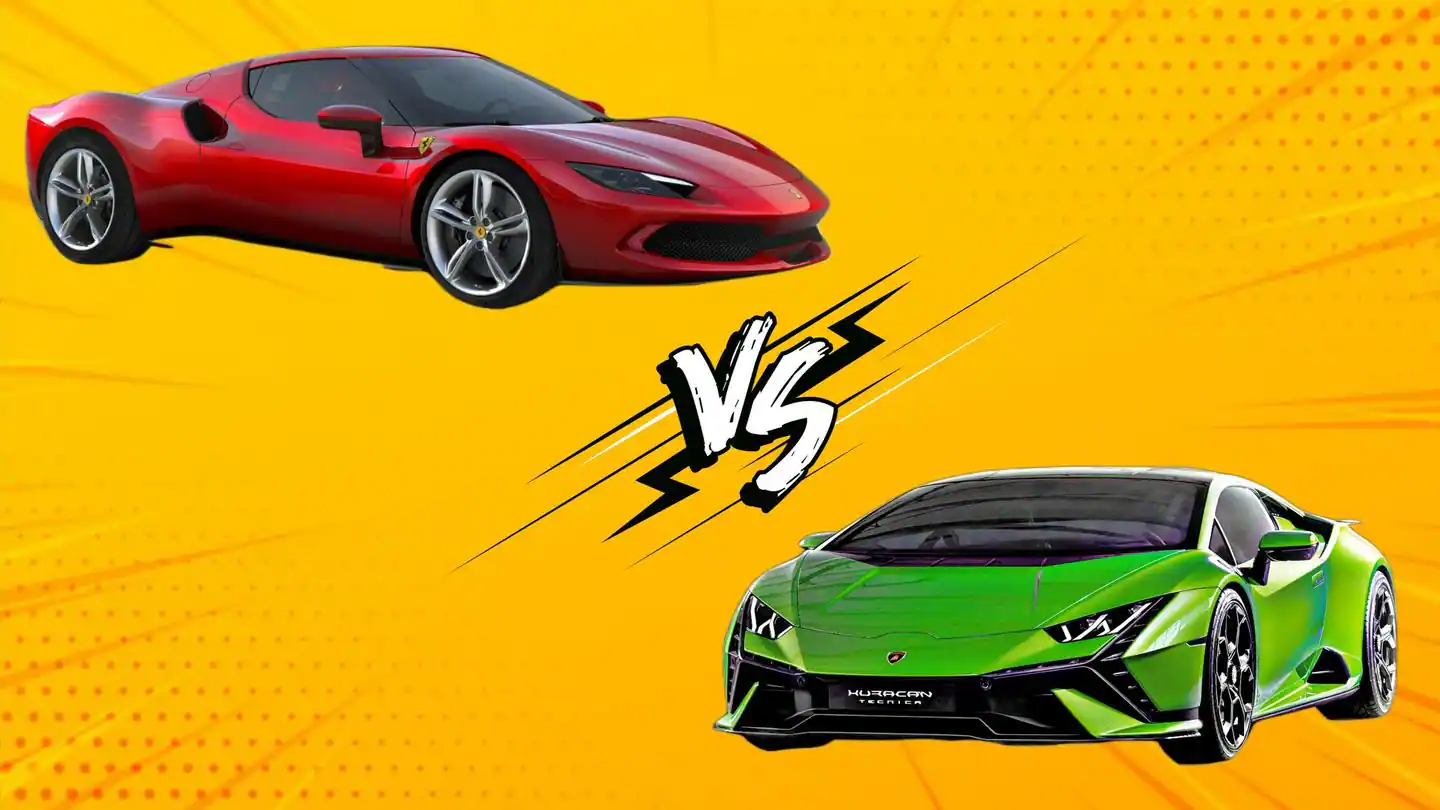
The Ferrari 296 Huracan comparison represents one of the most important transitions in modern supercar history. One car embraces hybrid innovation, while the other protects the legacy of a naturally aspirated V10.
The Ferrari 296 Huracan battle is not simply about horsepower figures. It is about philosophy, mechanical character, and the future direction of performance engineering.
Engine Architecture & Power
In the Ferrari 296 Huracan engine comparison, technology plays the defining role. The Ferrari 296 GTB uses a 3.0L twin-turbo V6 paired with an electric motor, producing around 830 horsepower combined. The Huracan EVO delivers its power from a 5.2L naturally aspirated V10 generating about 640 horsepower.
In Ferrari and Huracan analysis, torque matters just as much as peak output. The hybrid system eliminates turbo lag and delivers immediate acceleration. Acceleration in Ferrari Huracan feels brutal thanks to electric assistance at low RPM.
Performance & Acceleration
When analyzing Ferrari 296 Huracan in real-world acceleration tests, the headline numbers only tell part of the story. Both cars launch from 0–100 km/h in approximately 2.9 seconds, placing them in the same elite performance category. However, how they achieve that speed — and how they continue accelerating — is fundamentally different.
In controlled launch conditions, Ferrari 296 Huracan demonstrates two distinct power philosophies. The Ferrari relies on its hybrid-assisted torque delivery to create explosive initial thrust. The electric motor instantly supplements the twin-turbo V6, eliminating turbo lag and filling torque gaps during gear changes. This results in sharper throttle response and more consistent launch performance, especially when traction conditions vary.
Beyond 100 km/h, Ferrari 296 Huracan dynamics begin to separate more clearly. From 100–200 km/h, the Ferrari typically gains measurable distance due to its strong mid-range torque curve. The hybrid system continues delivering electric assistance deep into the acceleration phase, providing sustained pressure rather than a single peak surge.
Once speeds exceed 150 km/h, the aerodynamic efficiency and torque density of the Ferrari platform allow it to stretch ahead. In Ferrari 296 Huracan roll-race scenarios, the 296’s torque plateau gives it a noticeable advantage when exiting medium-speed corners or accelerating from highway speeds.
The Huracan approaches performance differently. Its naturally aspirated 5.2-liter V10 builds power progressively. Instead of immediate electric torque, the Lamborghini delivers mechanical crescendo. As RPM climbs toward 8,000+, the engine note intensifies and power increases in a linear, predictable arc. In Ferrari 296 Huracan comparisons, this linearity creates a sense of control and emotional build-up that many drivers prefer.
From a driver engagement perspective, Ferrari 296 Huracan acceleration feels distinct. The Ferrari produces a compressed, high-efficiency surge that feels modern and calculated. The Lamborghini delivers acceleration that feels organic, mechanical, and dramatic.
Gearbox behavior also plays a role in Ferrari 296 Huracan performance evaluation. The Ferrari’s 8-speed dual-clutch transmission shifts with near-seamless torque continuity, aided by electric fill during shift transitions. The Huracan’s 7-speed dual-clutch transmission is sharp and aggressive, but relies purely on engine momentum without hybrid smoothing.
On technical circuits, Ferrari 296 Huracan acceleration out of corners favors the Ferrari. Instant torque means earlier throttle application and stronger exit speed. On flowing high-RPM sections, however, the Huracan’s V10 delivers sustained emotional engagement as it climbs through its rev range.
From an engineering standpoint, Ferrari 296 Huracan highlights the future versus the final form of naturally aspirated performance. The Ferrari maximizes efficiency and torque density per liter. The Lamborghini maximizes mechanical purity and acoustic drama.
In summary, while 0–100 km/h times appear identical on paper, Ferrari 296 Huracan acceleration characteristics diverge significantly beyond launch control. The Ferrari dominates mid-range punch and real-world overtaking power. The Huracan excels in linear high-rev excitement and emotional acceleration buildup.
Both deliver extreme speed — but they achieve it in fundamentally different ways.
Driving Feel & Steering Feedback
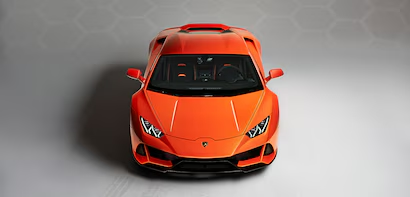
When driving Ferrari 296 Huracan back to back, the personality difference becomes obvious. The Ferrari feels precise and calculated. The Lamborghini feels dramatic and emotional.
Steering feedback in Ferrari 296 Huracan differs greatly. The 296 provides razor-sharp front-end accuracy. The Huracan offers slightly heavier steering and raw mechanical sensation.
Ferrari 296 Huracan highlights the contrast between data-driven control and analog engagement.
Aerodynamics & Stability
Aerodynamically, Ferrari Huracan highlights two different design strategies. The Ferrari integrates active aero surfaces and underbody airflow management to maximize downforce efficiency.
The Huracan EVO relies heavily on LDVI (Lamborghini Dinamica Veicolo Integrata), which optimizes torque vectoring and stability electronically.
Professional drivers note Ferrari Huracan stability improvements under heavy braking and high-speed corner entry compared to older supercar platforms.
Interior & Technology
Inside the cabin, Ferrari 296 Huracan reveals a generational shift in cockpit design. The Ferrari features a fully digital interface with hybrid energy displays and minimalist architecture.
The digital interface in Ferrari Huracan feels futuristic, whereas the Huracan maintains a fighter-jet inspired layout with bold switches and physical drama.
Ferrari Huracan testing shows that modern buyers increasingly value technology integration alongside performance.
Sound & Emotional Impact
Sound defines Ferrari Huracan in different ways. The Huracan’s V10 scream is mechanical art. It is loud, sharp, and deeply emotional.
The Ferrari V6, although turbocharged, is engineered with a unique firing order to maintain character. Yet emotion lovers will likely prefer the naturally aspirated roar.
Choosing between Ferrari Huracan depends largely on whether you prioritize raw acoustic excitement or next-generation torque response.
Track Capability & Lap Time Potential

During lap simulations, Ferrari Huracan testing shows the hybrid Ferrari gaining advantage in corner exit acceleration. The electric motor fills power gaps instantly.
Ferrari 296 Huracan shows how efficiency translates into lap consistency. The Huracan, however, rewards precise throttle modulation and skilled driving.
Ultimately, Ferrari 296 Huracan is not about which car is objectively superior. It is about which driving philosophy resonates more with the owner.
Market Position & Future Value
From a market perspective, Ferrari 296 Huracan ownership offers two distinct collector paths. The Huracan may become one of the last iconic naturally aspirated V10 models, increasing long-term desirability.
The future of Ferrari 296 Huracan philosophy signals electrified dominance. Hybrid systems are clearly shaping the next era of supercars.
That is why Ferrari 296 Huracan will remain iconic regardless of technological direction.
Final Verdict
The Ferrari 296 Huracan comparison defines a turning point in performance history. One car represents evolution. The other represents legacy.
If you want cutting-edge hybrid dominance, choose Ferrari.
If you want pure V10 drama, choose Lamborghini.
Both machines define excellence in different forms.
About the Author